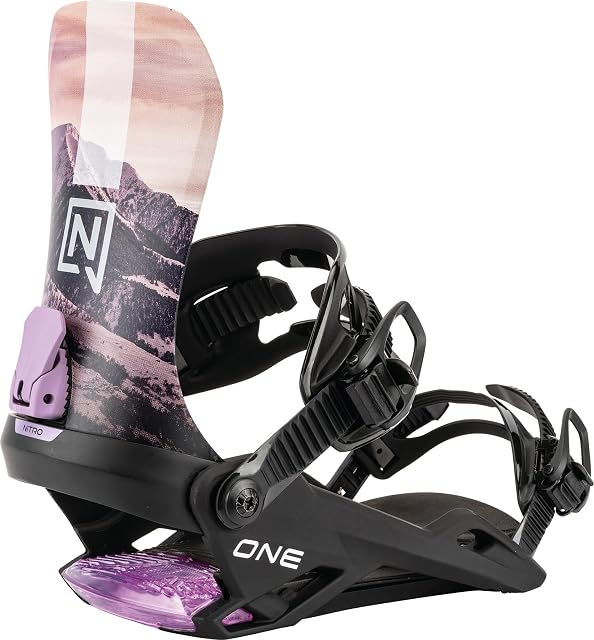
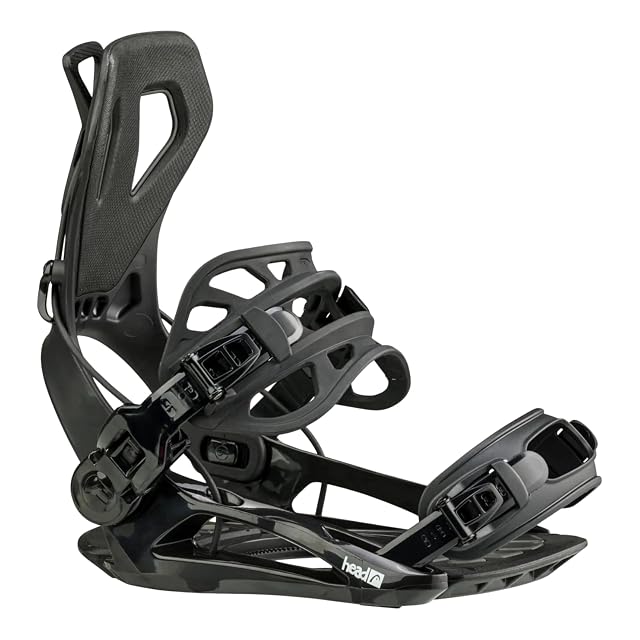
NITRO One
Flex 6/10, air damping, 3° canted footbed, over-toe or toe-cap strap
A binding whose flex figure comes with the scale it is measured on.
Best for: A rider between beginner and intermediate who wants a middle flex and knows it
Snowboard bindings
Flex 6 or flex 3 — and out of what?
Both of these listings print a flex number. One prints 6 out of 10; the other prints 3, with no scale beside it. That single difference is the reason this pair exists: a bare number on a snowboard binding is not a specification, it is a label, and there is no industry scale behind either.
| Compared on | One | RX One, Medium |
|---|---|---|
| Entry system | Strap, with a 3D OptiFrame ankle strap and an over-grip toe strap | Strap, with a toe strap and an ankle strap described |
| Size range | Not published | Medium; no boot-size mapping published |
| Highback | Not published separately; flex stated as 6 out of 10 | Not published; flex index stated as 3 |
| Baseplate pattern | Not published | Not published; an FT1 base with a light PA frame is stated |
| Adjustment | The toe strap fits over the toe cap or around it | Stated as adjustable in seconds and without tools |
| Disc supplied | Not published | Not published |
| Weight per pair | Not published | Not published |
| Listed on amazon.com | Yes | Yes |
A tick means one listing published something the other did not, or published a better figure. It does not mean the product is better, and the column is not a score out of anything: a maker who says less loses lines here without losing a comparison. The two verdicts below are where the page is settled.
The only binding on its shelf whose flex figure arrives with the scale it was measured on. It also describes its straps as components rather than as features, and it explains that the toe strap can be worn over the toe cap or around it — the detail that decides how a binding holds a soft boot.
Cheaper, and it publishes a size where the NITRO publishes none — but "Medium" without a boot-size mapping is a letter, not a size. Its flex index of 3 has no scale behind it, so it cannot be set against the 6 out of 10 beside it, and this page does not pretend otherwise.
Not between makers, and here not even in principle: one is out of ten and the other is out of nothing stated. Flex numbers are internal to a range. Within one maker they rank that maker’s bindings; between makers they rank nothing.
Because the binding bolts to the board through a disc, and the disc has to match the board’s insert pattern — 2×4, 4×4 or a channel. Neither of these publishes a pattern, and neither says which disc is supplied. On this site exactly one board publishes its insert pattern.
The boot sizes each binding size accepts. Only one binding on this whole site publishes the mapping — M for 38–41, L for 41–44, XL for 44–47 — and it is on a different shelf entry. Everywhere else, including both of these, the letter is left to the buyer to interpret.
Flex 6/10, air damping, 3° canted footbed, over-toe or toe-cap strap
A binding whose flex figure comes with the scale it is measured on.
Best for: A rider between beginner and intermediate who wants a middle flex and knows it
Strap binding, flex index 3, EVA pads, tool-free adjustment
A soft strap binding that describes four components properly and then gives a flex number with no scale.
Best for: A rider who wants a soft, forgiving strap binding and will set it up themselves
≈ $170
The live figure beside a product went and asked the shop for it the moment this page opened; any amount written into the text has not moved since the sentence was drafted, and it is the first of the two that counts.