For children
Getting a child onto snow, without buying it twice
The problem with children’s ski kit is not the price of any one item; it is that a child changes shoe size in a year and head size in two. So this list is ordered by how well each item survives growth — the adjustable things first, the fixed things last, and one item that is worth buying new every time.
By Jean-Benoit Buisson
Six purchases, ordered by how long each one lasts.
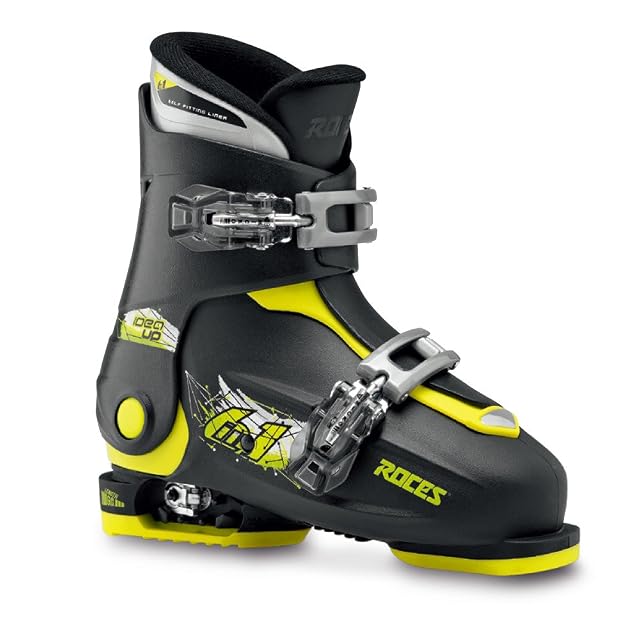
1. The boot that grows five sizes
The Roces here adjusts across EU 30 to 35. That is the difference between one purchase and three.
What its listing does not do is explain how the adjustment works — three bullet points that say nothing at all about the mechanism — so this is a case where the shelf page is more use than the seller’s text.
2. The helmet, sized in centimetres
The ALPINA children’s hardshell is sold as 51–55 cm with removable ear pads and a neck warmer built in. Measure round the head above the ears with a tape and the choice is made.
Compare that with the other children’s helmet on this site, sold under a size code only its maker uses.
3. The goggle the helmet names
The ALPINA goggle is the one that helmet names as its match. It is the only named helmet-and-goggle pairing on this site, and it solves the gap problem without a shop visit.
4. Poles that extend
The Kadva pair is telescopic from 60 to 100 cm, and the listing maps that to children of 100 to 155 cm in height — forty centimetres of adjustment, published against the heights it covers.
Cheapest item here, longest life.
5. The binding, which is the part that must be right
The Fischer junior binding publishes a full Z-DIN range of 2 to 7.5 and names both sole standards it accepts, GripWalk and alpine. Nothing else on that shelf does both.
A junior DIN range starting at 2 is the point: a light child needs a release setting an adult binding cannot reach.
6. The ski, last, and the one thing worth replacing often
The Atomic here is a 150 cm junior race ski, and it is the only child’s ski on its shelf.
A ski is the item a child grows out of fastest and the item that matters least while they are learning. Buy it shortest on this list’s timeline, and buy it again when their height demands it.
Questions this guide leaves open
Does an adjustable boot really work?
It buys years rather than fit. The Roces here adjusts across five EU sizes, which is two or three seasons for most children; what it does not give is the precise hold of a shell moulded to one size. For a child skiing a week a year that is the right trade, and for a child racing it is not.
Why is the helmet sized in centimetres a point in its favour?
Because a head measured with a tape can be matched to a range, and a head cannot be matched to the letter S. Most children’s helmets on this site are sold by size code or by letter; the ALPINA is sold as 51–55 cm, and that is checkable at home before ordering.
Should the goggle match the helmet?
It should sit against it without a gap. The ALPINA goggle on this shelf is the one the ALPINA helmet names as its match — the only named pairing on this whole site — which removes the guesswork that otherwise leaves a strip of a child’s forehead exposed.
Second-hand skis for a child?
Reasonable, with one condition: the binding must be checked and set by a workshop for the child’s current weight and boot length. A binding set for last year’s child is the one part of a second-hand setup that can hurt.